
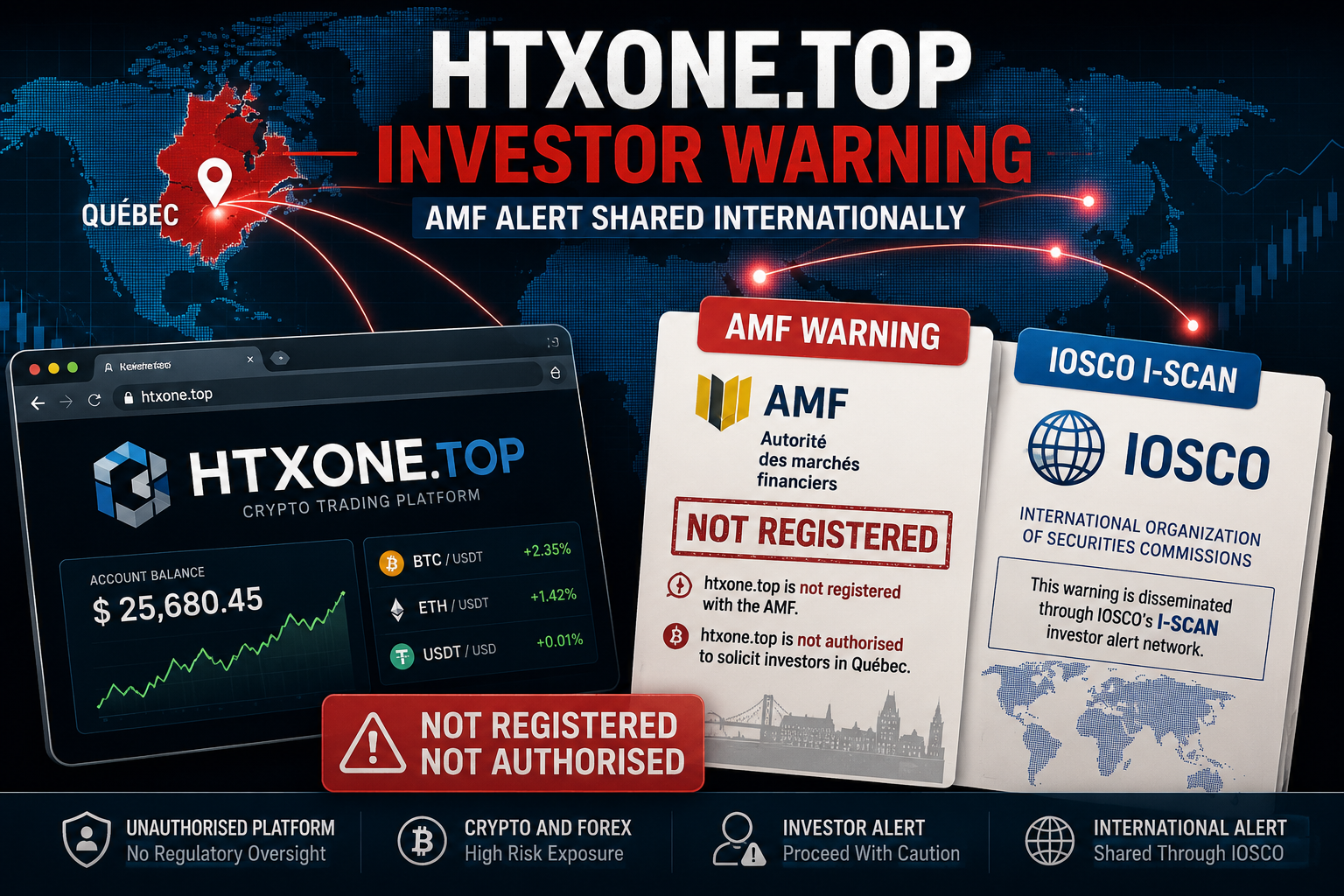
A regulatory warning can begin as a short entry in one jurisdiction and then travel through an international alert-sharing network. That process is important because online investment platforms do not necessarily restrict their activities to one country.
The warning concerning htxone.top illustrates how that system works.
On July 24, 2026, the Autorité des marchés financiers (AMF) published an official investor warning against the website. The notice states that htxone.top is not registered with the authority and is not authorised to solicit investors in Québec.
The warning has also been reported through the International Organization of Securities Commissions (IOSCO) investor-alert network, increasing the visibility of the regulatory concern beyond Québec.
This does not mean that two regulators necessarily carried out separate investigations. The International Organization of Securities Commissions (IOSCO) operates an international warning-sharing system through which alerts issued by participating financial authorities can be made available to investors and regulators in other jurisdictions.
For anyone researching htxone.top, the central fact remains unchanged: the platform has been named in an official warning stating that it lacks the registration and authorisation required to solicit investors in Québec.
Layer One: The Warning Issued in Québec
The first layer of the alert comes directly from the Autorité des marchés financiers (AMF).
The official notice identifies the following information:
- Website: htxone.top
- Warning date: July 24, 2026
- Regulatory status: Not registered
- Authorisation status: Not authorised to solicit investors in Québec
- Warning categories: Cryptoassets and high-risk platforms
The wording is brief, but its meaning is significant. Registration is not a decorative feature or a marketing badge. It establishes whether a firm has permission to carry out particular financial activities within a regulator’s jurisdiction.
When the Autorité des marchés financiers (AMF) states that a website is not registered and is not authorised to solicit Québec investors, consumers should not rely on assurances supplied by the website or its representatives as a substitute for official verification.
An account manager may claim that a company is “internationally regulated,” “registered overseas,” or “licensed for cryptocurrency trading.” Those statements must be verified independently through the official register of the authority supposedly responsible for supervising the business.
Layer Two: Why the IOSCO Alert Matters
The second layer involves the International Organization of Securities Commissions (IOSCO).
The organisation’s investor-alert system helps make warnings from securities regulators accessible across borders. This is particularly relevant to internet-based investment operations because a platform may use one website to approach people in several countries.
The appearance of the htxone.top warning through the International Organization of Securities Commissions (IOSCO) alert network should therefore be understood as an international circulation of the regulatory warning rather than proof that the website has been authorised anywhere else.
Investors sometimes make the mistake of believing that a platform is safe because a warning was issued in another province or country. That reasoning is dangerous. A border does not change the ownership of a website, the destination of a cryptocurrency transfer or the identity of the person controlling a receiving wallet.
The international visibility provided by the International Organization of Securities Commissions (IOSCO) network allows consumers outside Québec to discover that an official concern has already been recorded.
The Verification Gap
The central issue in the htxone.top warning is what may be called a verification gap.
A platform can present many signs of apparent legitimacy:
- A professionally designed homepage
- Live cryptocurrency prices
- Charts showing supposed market activity
- Personal account managers
- Displayed investment profits
- Documents carrying official-looking seals
- Claims of offices in major financial centres
None of these items independently confirms regulatory authorisation.
The correct verification process moves away from the platform’s own materials and towards external evidence. An investor should identify the precise legal entity, locate it in the official register, confirm the services it is allowed to provide and establish whether the exact website domain belongs to that entity.
Where the Autorité des marchés financiers (AMF) has already stated that htxone.top is not registered or authorised to solicit investors in Québec, the burden should not be placed on the investor to disprove the warning. The platform would need to provide independently verifiable evidence of lawful authorisation in the jurisdiction where its services are being promoted.
The Five Questions a Sales Representative Should Be Able to Answer
Before sending money to any online trading or cryptoasset platform, ask five direct questions:
1. What is the full legal name of the operating company?
A commercial brand and a legal entity are not necessarily the same thing. The company named on the website should match the company named in contracts, invoices and receiving-bank information.
2. Which regulator has authorised the company?
The answer should name a specific authority, not use vague expressions such as “globally regulated” or “internationally compliant.”
3. What is the licence or registration number?
The number should be searchable on the regulator’s official website. A screenshot sent by an account manager is not enough.
4. Does the licence cover the services being promoted?
A business registered for one activity may not be permitted to offer investment advice, brokerage, derivatives or managed cryptocurrency products.
5. Is htxone.top listed as an approved website?
Unauthorised websites sometimes copy the name, address or registration information of a genuine company. Verifying the domain is therefore as important as verifying the company name.
Follow the Money, Not the Dashboard
An online account may display a growing balance, profitable trades and available withdrawal amounts. Those figures should not automatically be treated as proof that genuine assets exist.
The payment route provides more useful evidence.
Anyone who has transferred funds in connection with htxone.top should preserve:
- The recipient’s bank name and account number
- The beneficiary or account-holder name
- Cryptocurrency wallet addresses
- Blockchain transaction hashes
- The network used, such as Bitcoin, Ethereum or TRON
- Exchange purchase receipts
- Card payment references
- Invoices and payment instructions
Particular caution is warranted when the receiving account belongs to an individual or to a company whose name is unrelated to the platform. The same applies where investors are instructed to purchase cryptocurrency through a legitimate exchange and then transfer it to an external wallet controlled by the supposed investment provider.
Never misrepresent the purpose of a payment to a bank, card provider or cryptocurrency exchange. If a representative tells you to describe an investment deposit as a personal transfer, purchase or gift, preserve that instruction as evidence.
The Withdrawal Test
The most revealing stage of an online investment relationship often begins when the customer attempts to withdraw.
Before a withdrawal request, communication may be frequent and encouraging. A representative may discuss profits, higher account levels or new opportunities. Once the investor asks for money back, the conversation may change.
Warning signs include:
- A withdrawal remaining pending for an unexplained period
- A request for an advance tax payment
- A demand for a liquidity or insurance fee
- A claim that the account must first be upgraded
- A requirement to make another deposit
- A demand for a blockchain verification payment
- Threats that the balance will be forfeited
- Repeated excuses without a completed transfer
Taxes and fees deducted by legitimate financial institutions are not normally paid by sending cryptocurrency to an unknown external wallet. Any unexpected payment demand should be independently verified before further funds are transferred.
What to Preserve If You Have Already Dealt With htxone.top
A well-organised evidence file is more useful than a collection of disconnected screenshots.
Create a timeline beginning with the first contact and include:
- The date and platform through which you were approached.
- The name or alias used by each representative.
- Telephone numbers, email addresses and social-media profiles.
- The exact website domain and login pages.
- Every payment, listed by date, amount and destination.
- Wallet addresses and transaction hashes.
- Copies of account statements and displayed balances.
- Withdrawal requests and all responses received.
- Requests for taxes, fees or additional deposits.
- Identity documents or financial information supplied.
Preserve voice messages and call records where possible. Do not edit screenshots in a way that removes dates, website addresses or identifying information.
The Autorité des marchés financiers (AMF) warning itself should also be saved as part of the evidence record. The related listing through the International Organization of Securities Commissions (IOSCO) network may provide additional context when reporting the matter outside Québec.
Immediate Steps After a Suspected Loss
Where funds have already been sent, consider acting promptly:
- Stop additional payments while the matter is reviewed.
- Contact the bank, card provider or cryptocurrency exchange involved.
- Provide truthful information about how the transaction occurred.
- Ask whether a transfer recall, fraud report or dispute procedure applies.
- Secure your email, exchange and banking accounts.
- Change passwords that were shared or reused.
- Remove remote-access applications you were instructed to install.
- Enable multi-factor authentication wherever available.
- Report the matter to the appropriate authorities in your jurisdiction.
Recovery depends on factors including the payment method, the speed of reporting, the location of the recipient and whether funds have already been moved. No legitimate investigator should guarantee that all money will be recovered.
Watch for a Second Scam
After an investment loss, victims may be contacted by someone claiming to work for a government agency, law firm, blockchain investigation unit or recovery company.
The caller may already know the platform name and the amount lost. That knowledge does not prove legitimacy.
Be especially careful when someone claims that funds have already been located but requires an upfront tax, release fee, wallet activation charge or legal deposit. Independently contact any regulator or institution named in the approach.
Neither the Autorité des marchés financiers (AMF) nor the International Organization of Securities Commissions (IOSCO) should be contacted through telephone numbers, messaging accounts or links supplied by an unverified recovery agent. Use the official websites directly.
Related Retrieve Lost Token Investigations
Regulatory alerts frequently reveal recurring patterns involving unverified licences, unclear company identities and withdrawal-related demands. Readers may also review these previously published reports:
- Mutual Care Vault Trader (trade.mutualcarevault.com) – FCA Warning
- Prominent Hold Global (prominentholdglobal.com) – AFM Boiler Room Warning
- Sevlushfoods (sevlushfoods.com) – Investor Warning
- LambdaTrade (lamdatradeua.org) – Regulatory Alert
- Ethera 365 (ethera-monetix.com) – Québec AMF Warning
Comparing several alerts can help investors recognise how unauthorised platforms attempt to create trust through professional websites, unsupported regulatory claims and artificial account balances.
Final Regulatory Assessment
The warning against htxone.top is not based on speculation or an anonymous online complaint.
The Autorité des marchés financiers (AMF) has stated that the website is not registered with the authority and is not authorised to solicit investors in Québec.
The warning’s circulation through the International Organization of Securities Commissions (IOSCO) alert network gives investors outside Québec another opportunity to discover the regulatory record.
Anyone considering htxone.top should stop before transferring funds, independently verify every claimed licence and confirm the identity of the company or individual receiving the money.
Take The Next Step
If you believe you have been affected by htxone.top:
👉 Contact Retrieve Lost Token for a case review
👉 Speak directly with our team about your transaction records
No upfront recovery fees. Fees apply only after a successful recovery outcome.
Disclaimer
This article is based on publicly available information released by the Autorité des marchés financiers (AMF) and circulated through the alert resources of the International Organization of Securities Commissions (IOSCO), together with publicly available educational information. It is intended solely for educational and informational purposes and should not be interpreted as legal, financial or investment advice.